Vision Preview — In Development

Oracle incidents resolved
in minutes, not hours.

An agentic AI platform that autonomously diagnoses Oracle EBS and Fusion failures — and routes human-governed fixes through a built-in approval framework.

Platform Phases4
Risk Tiers3
Diagnostic Scripts65
Audit StandardSOX / ITGC
Unreviewed High-Risk Fixes0
4Platform Phases
3Risk Tiers
65Diagnostic Scripts
SOXCompliant Audit Trail
0Unreviewed High-Risk Fixes

Oracle support is still manual. It doesn't have to be.

Every Oracle ERP team faces the same cycle: an incident fires, a consultant is called, scripts are run by hand, support notes are searched manually. The tools exist to automate all of it.

⏱ Hours Lost to Diagnosis

A DBA manually running diagnostic queries, cross-referencing Oracle Support notes, and assembling a root cause analysis takes hours. The platform does it in under five minutes.

🔍 Knowledge Lives in People

Every resolved incident is institutional knowledge — but it stays in someone's head or a disconnected ticket. The platform captures every resolution and makes it searchable for the next incident.

🔒 No Audit Trail for Fixes

Manual DBA fixes leave no signed record of who did what, why, and what changed. SOX and ITGC controls require exactly that — and the platform generates it automatically for every action.

📋 Oracle Support Notes Are Walls

My Oracle Support requires authentication, manual searching, and expert interpretation. The platform retrieves, ranks, and applies relevant support notes automatically for every detected error code.

⚡ Period Close Pressure

An unresolved invoice hold at month-end is not an AP problem — it is an executive problem. Fast, governed resolution is the difference between closing on time and a board-level conversation.

🔄 The Same Incidents Repeat

Without a knowledge base that learns from resolutions, the same ORA errors, the same holds, and the same interface failures recur indefinitely — treated as a new incident by the next consultant on the ticket.

From incident alert to governed fix — fully automated.

The ORA-01652 incident below is a real example. The platform handles every step autonomously — and stops for human approval before touching production data.
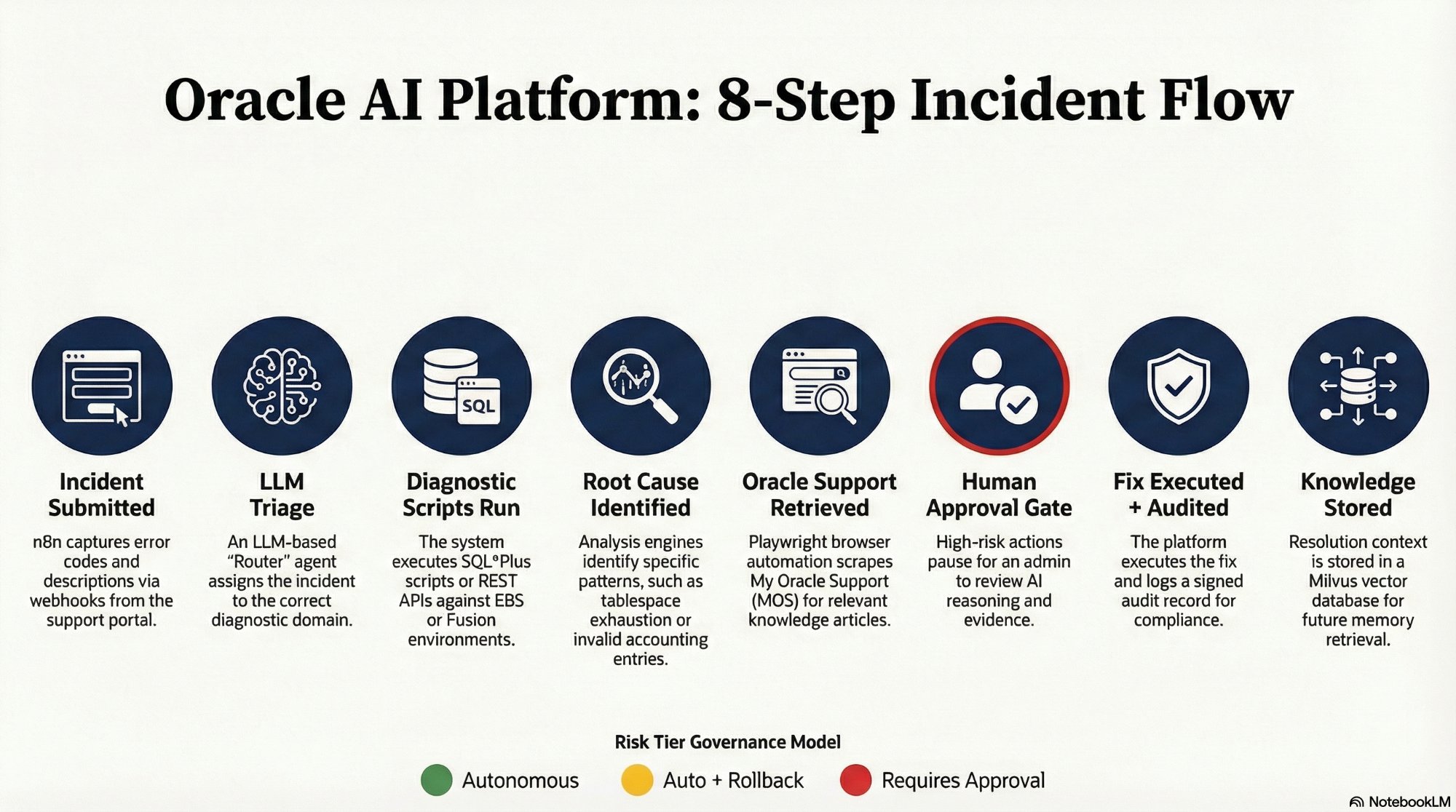
Oracle AI Platform 8-Step Incident Flow — Incident Submitted, LLM Triage, Diagnostic Scripts, Root Cause, Oracle Support, Human Approval Gate, Fix Executed, Knowledge Stored

Every Oracle incident follows the same 8-step sequence. Step 6 is the only step that requires a human — every other step runs autonomously.

01
User → Support Portal

Incident Submitted

A user submits "Invoices stuck in INCOMPLETE status with ORA-01652." The portal captures the error code, module, and description as a structured JSON payload sent to n8n via webhook.

02
n8n → LLM Router

Triage & Classification

An LLM-based router agent classifies the incident domain and dispatches the correct diagnostic workflow — in this case, a DBA-level tablespace issue.

03
Script Agent → Oracle DB

Diagnostic Scripts Execute

The platform triggers the Tablespace Diagnostic Script from the 65-script library. SQL runs against the Oracle database and returns structured JSON for LLM analysis.

04
LLM Analyst → Claude / GPT-4o

Root Cause Identified

Result: TEMP tablespace at 99.8% utilization. Root cause confirmed. Resolution path generated: extend TEMP tablespace by 5GB.

05
Playwright → My Oracle Support

Oracle Support Knowledge Retrieved

The browser agent authenticates into My Oracle Support, searches ORA-01652 TEMP Tablespace, and retrieves the top-ranked knowledge article — without human involvement.

06
HITL Node → DBA via Slack

Human Approval Required

Because ALTER SYSTEM is a High-Risk action, the platform pauses. The lead DBA receives a Slack notification with the AI reasoning and an Execute Fix button. Nothing runs until they approve.

07
n8n → OracleDB Node

Fix Executed & SOX Audit Logged

Upon approval, the tablespace extension executes. A signed audit record captures who approved, what SQL ran, and the before/after state.

08
RAG → Milvus Knowledge Base

Resolution Stored for Next Time

The complete resolution is vectorized and stored in Milvus. The next ORA-01652 incident retrieves this resolution in seconds.

Full Incident Walkthrough →

Three risk tiers. Zero unreviewed production changes.

Every platform action is classified before execution. The traffic light system determines whether the platform proceeds autonomously or pauses for human approval.

🟢 Low Risk — Read-Only

Fully Autonomous

Diagnostic and read-only actions run without human involvement. Results are reported directly to the submitting user with no approval step required.

SELECT tablespace_name, used_percent
FROM dba_tablespace_usage_metrics;
✓ Report sent automatically
🟡 Mid Risk — Non-Destructive

Human-on-the-Loop

Non-destructive management actions auto-execute, but an Instant Rollback button remains available to the admin for a defined time window.

Re-run failed Concurrent Program;
purge old log files from spool.
⚡ Auto-execute + rollback available
🔴 High Risk — Data Correction

Human-in-the-Loop

Any action touching production data or system configuration requires explicit admin approval. The platform serializes state and waits for a signed decision.

UPDATE stuck interface table;
ALTER SYSTEM extend tablespace.
🔒 Admin approval required
Full Governance Framework →

Four phases. One complete system.

The platform is designed in four distinct, interlocking phases — each buildable independently, each adding a layer of autonomous capability.

Built on proven enterprise tools.

Every component is production-grade, self-hostable, and designed for Oracle ERP environments where security and compliance are non-negotiable.

⚙️
n8n — Orchestration

Self-hosted workflow engine managing the full incident lifecycle from webhook ingestion through approval routing to fix execution.

🧠
Claude / GPT-4o — Intelligence

LLM analysis of diagnostic output for root cause identification, resolution synthesis, and knowledge base article generation.

🌐
Playwright — Browser Automation

Containerized stealth browser agent for authenticated My Oracle Support retrieval — session-persistent, MFA-aware, and headless by default.

🗄️
Milvus — Vector Storage

High-performance vector database for Oracle diagnostic knowledge with metadata filtering by ERP version, module, and error code.

🔗
JDBC / REST / SSH — ERP Connectivity

Native Oracle EBS connectivity via JDBC and SQL*Plus. Oracle Fusion via REST APIs. Application tier access via SSH for system-level diagnostics.

📜
65 Diagnostic Scripts — Foundation

Powered by the same production-grade scripts at scripts.williamagreen.com — peer-reviewable, versioned, and tested across 11 Oracle modules.

Full Technology Stack →

From the platform build.

Technical deep-dives on building an autonomous Oracle support system — written for DBAs, Oracle architects, and IT leaders.

View All Posts →

Interested in what this platform can do for your Oracle environment?

This is a vision under active development. We are talking to Oracle teams who want to be part of shaping it.

Start the Conversation →